


Day 1 – Foundations of Emotion Focused Therapy
Day 1 is devoted to building a solid conceptual and experiential foundation in contemporary emotion theory as understood within Emotion Focused Therapy. Participants will develop a nuanced understanding of different types of emotional responses—primary adaptive, primary maladaptive, secondary, and instrumental emotions—and their role in psychological functioning and distress.
A central focus will be placed on how therapist empathy facilitates productive emotional processing. From an EFT perspective, empathic attunement is not only relational but also process-guiding—it helps clients access, symbolize, regulate, and transform emotional experience. Understanding these mechanisms forms the foundation of EFT practice and supports therapists in facilitating meaningful emotional change.
Day 2 & Day 3 – Adapting EFT to Work with Youth (EFT-Y Model)
The development of EFT-Y was motivated by the intention to expand the range of therapeutic approaches available to both clients and therapists—offering another meaningful pathway for growth and healing.
In EFT-Y, we focus primarily on emotion processes and non-verbal (implicit) processes.
Emotion processes—and their disruptions—are understood as the core source of suffering in adolescents and their families. In collaboration with both the young person and their caregivers, the therapist works to restore a healthy flow of emotions so that they can once again function as an adaptive compass, helping individuals navigate the complexity of emotional and relational life.
Non-verbal processes are treated as a vital entry point into the adolescent’s inner world. They provide essential cues that guide the therapist in understanding where the core pain lies and how to move toward relief. This is especially important because adolescents often struggle to identify, articulate, or symbolize their emotional experience. Even when emotions are not yet fully conscious or verbalized, the suffering is real—and non-verbal expressions serve as critical markers pointing toward it.
Dates and registration fee
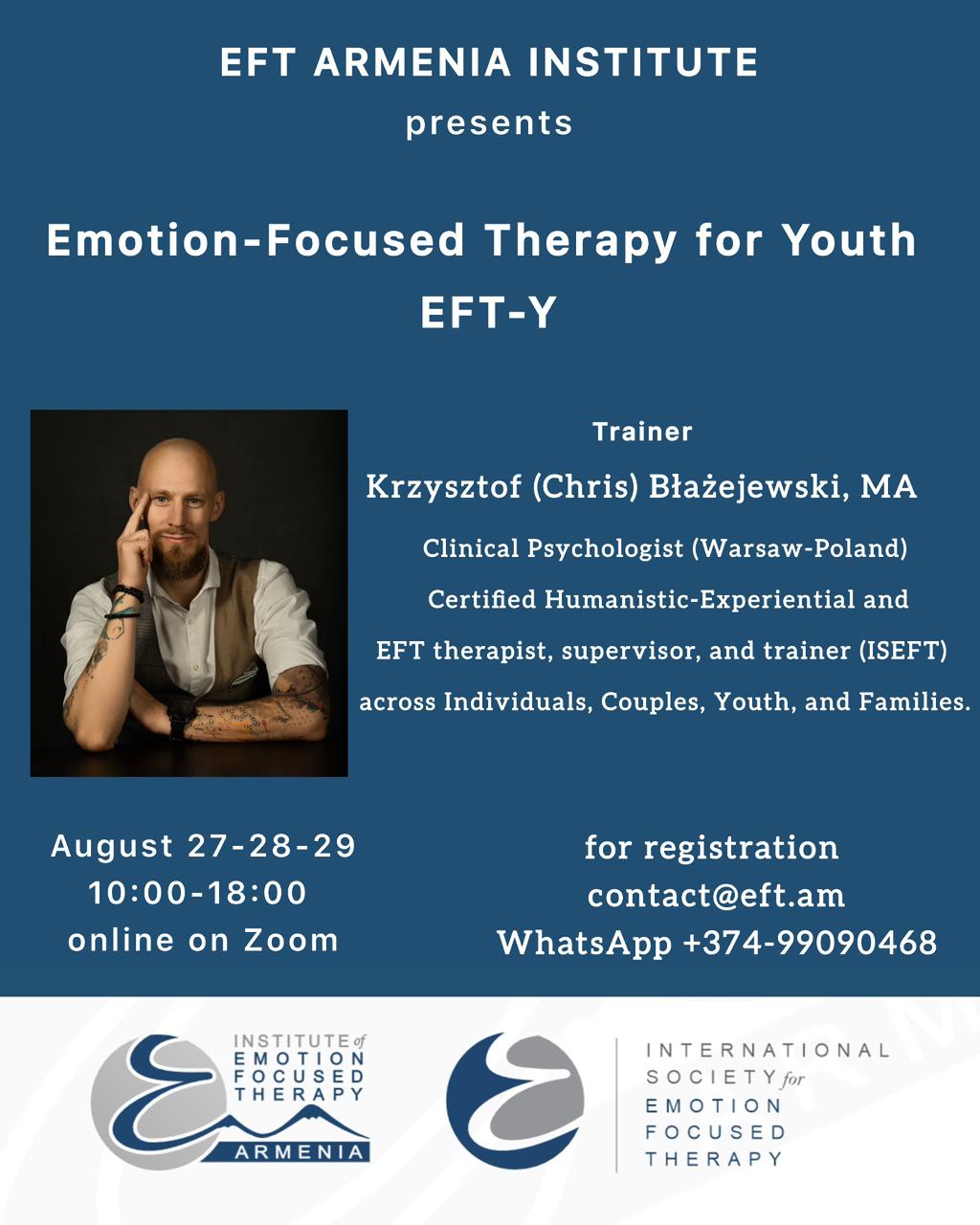
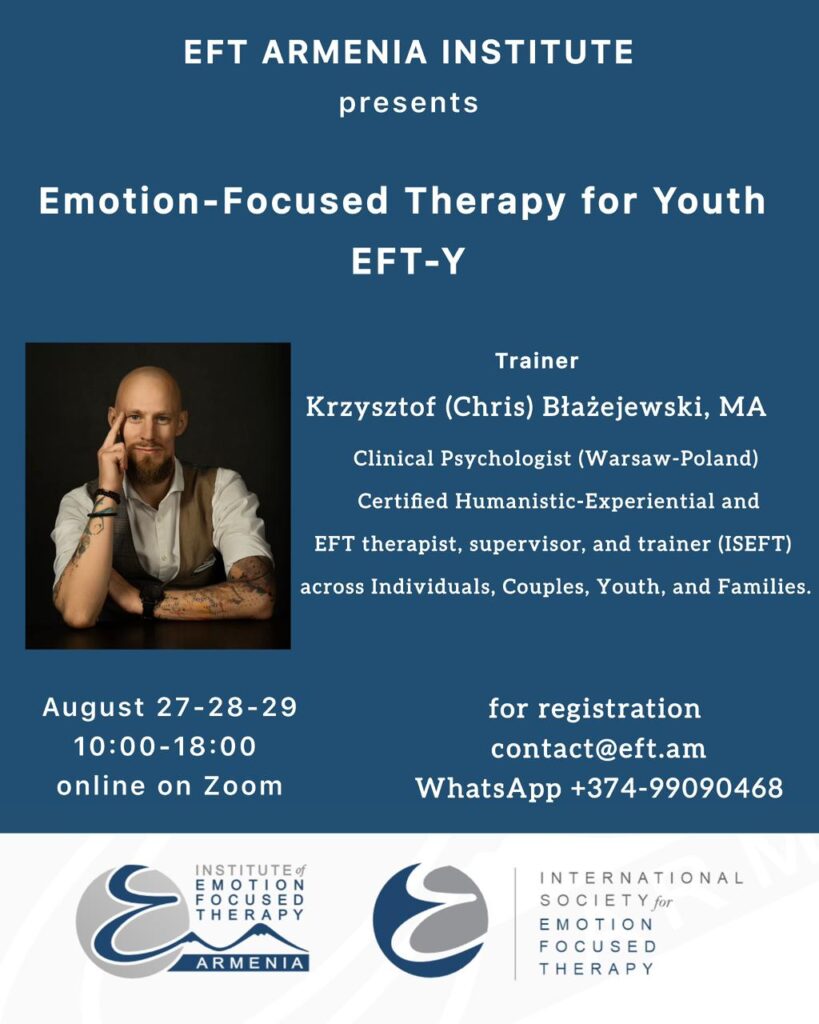
August 27-28-29 , 2026
10:00-18:00 (GMT+4)
Online on Zoom
Fee: 170000 AMD
Training Content Overview 🧠💗
Day 1
- EFT-Y from a “bird’s-eye view”: Overview
- Core concepts and theory:
- Theoretical foundations of EFT-Y
- Contemporary understanding of emotion: primary adaptive, primary maladaptive, secondary, and instrumental emotions
- Experiential work with emotions: moment-by-moment process diagnosis
- Tasks and markers in EFT – a therapeutic “GPS”
- Emotional transformation as the core mechanism of change
Experiential Practice (group work):
Opening specific channels of sensitivity in working with adolescents 💗
Day 2
- EFT-Y in depth: an experiential journey
- Working with non-verbal (implicit) processes 😶
- Emotion activation and regulation of overwhelming affect
Experiential Practice:
- (triads) Empathic attunement training
- (pairs)
- Chair work with youth (ages 9–18) 🪑
- Working with emotional self-interruption processes 💔
- Advanced empathic skills
- EFT-Y process illustrated through work with Generalized Anxiety Disorder (GAD)
- Emotion schemes: what they are and why they matter
Day 3.
- Continued experiential chair work practice
- Emotion processing in chair work:
- Emotion self-interruption processes
- Conflict splits within the self
- The “parent as witness” (imagined significant other)
- Accessing core emotion pain through witnessing
- Vulnerability splits
- Unfinished business with significant adults and opening work within the parent-child dyad
- Experiential exercises:
Adjusting emotional intensity to the adolescent’s developmental capacity - Benefits and challenges of EFT-Y
- Goals of working with the parent-child dyad in EFT-Y
Experiential Practice (pairs):
- Chair work: conflict splits within the self
Experiential Practice (pairs):
- Chair work:
- Parent as witness
- Working with imagined caregivers
- Unfinished business with significant adults
What Will You Gain? 🤔
- Extensive hands-on experiential practice
- A deep understanding of key principles of Emotion-Focused Therapy
- The ability to use markers and tasks effectively—a therapeutic “GPS” in EFT-Y
- Practical skills in working with emotion activation and using empathy as a mechanism of change
- A clear understanding of how to adapt EFT to working with adolescents, including:
- Developmental considerations in children and adolescents
- A systemic perspective, including working with families and parent-child relationships
About Trainer
Krzysztof (Chris) Błażejewski, MA
is a psychologist and certified Humanistic-Experiential psychotherapist based in Warsaw, Poland. He gained clinical experience in adolescent psychiatric-psychotherapy units and previously worked on psychiatric and psychotherapy wards at Poland’s largest psychiatric hospital. He now runs a private psychotherapy practice in Warsaw, working primarily in family-adjacent contexts with adolescents, caregivers, co-parents, couples, and whole families.
Chris develops within Emotion-Focused Therapy (L. Greenberg) and practices across EFT for Individuals, Couples, Youth, and Families. In his supervisory, training, and clinical work, he emphasizes creating conditions that foster growth not only in knowledge and skills, but also in becoming “better at feeling.” He integrates a dialectical-constructiviststance—prioritizing robust case formulation outside sessions—with deep in-session empathic attunement and a particular focus on empathic resonance.
Beyond EFT, he refers to Focusing-Oriented Therapy, which informs his process-sensitive, moment-by-moment attention during sessions. He is also developing in Attachment Narrative Therapy (ANT), which brings together systemic, attachment, and narrative perspectives; attuning across these three levels enhances sensitivity to family relationships, attachment histories, and the meaning-making narratives families build. In his work, Chris places particular emphasis on Relational Therapeutic Presence as the pre-condition for any meeting that has a real chance to be healing and growth-promoting.
He is passionate about supporting supervisees in their professional development, strengthening their sense of efficacy and trust in their own felt experience as therapists—because, at the end of the day, they are the ones who sit across from clients and accompany them in change.
Selected training & certifications (ISEFT):
- Emotion-Focused Therapy for Youth — certified therapist, supervisor, and trainer
- Emotion-Focused Therapy for Family — certified supervisor
- Emotion-Focused Therapy for Individuals — certified therapist
- Emotion-Focused Therapy for Couples — certified therapist
